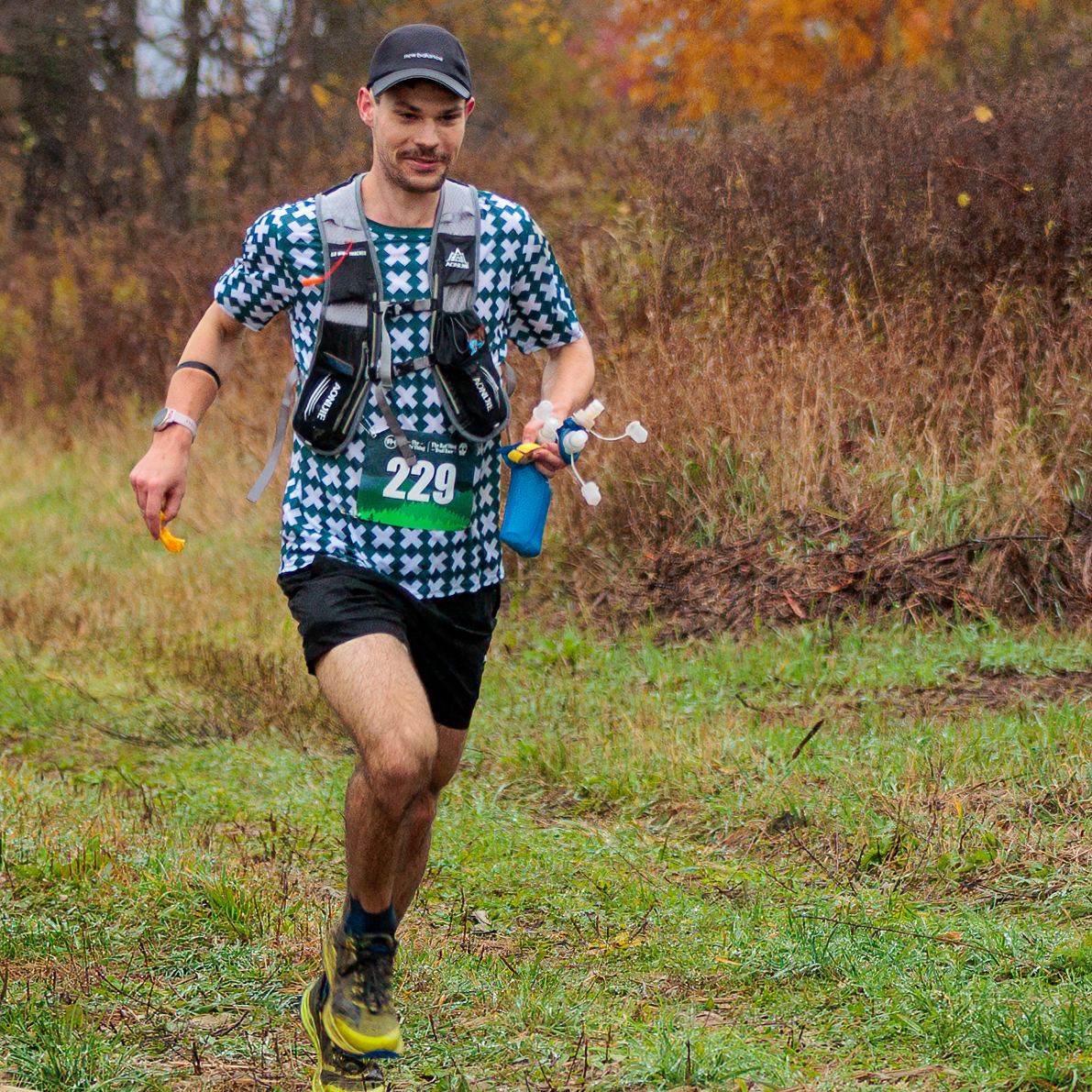

Normally when I finish a race, I’m jumping for joy (or limping through the airport with joy), excited to write a post-race recap of my experience.
I do this as a library for myself to help improve my experiences at future races, and help other athletes do the same – especially those I coach.
But truth be told, I’ve never wanted to pretend a race didn’t exist more.
I’ve had only a few “bad races” in the past couple of years. Usually when it happens, like Gorge 2024 or QMT 2025, my legs give out on me, and I rally through pain for hours to will my way to the finish.
While I was tremendously disappointed with those two experiences, I could still be proud that I worked for hours, willing myself to the finish line when everything in my body was telling me to give in and give up.
As someone who helps professional athletes and sporting clubs through performance problems, it feels embarrassing to say that I couldn’t even find the courage to try on Saturday.
Most of that feeling came down to two things:
- I had already decided before the race that I didn’t want to be there.
- I had entered race week sick. I hoped it wouldn’t matter. But I underestimated how much that would play into my mentality, let alone my physicality on the day.
Normally when I come to Quebec, I embrace all of it. I embrace having to switch to French. I embrace being slightly out of my depth against the best runners in the country. I embrace the crazy courses. I embrace spending the money and the time flying or driving over there.
I didn’t embrace it the same way this weekend.
I arrived late the night before the race with little time to adjust to the time difference. I woke up, and went to the race. There was little time to really process being there, settling in, going for a jog to shake-out the stiff legs from the plane. Not the best planning on my part, but I’ve been trying to save money lately.
Speaking of which, I would have refunded this race had there been an option. The only option was a “transfer” and, well, it’s harder to refund travel.
Beyond being sick and the poor planning, the problem was that I hadn’t managed to get on trails for the 8-10 weeks prior, since Run Ridge Run 25K in late February. I spent March out with an adductor injury, and then raced a 10K in April – another race with a strict refund policy.
The only time I managed to get on trails was the week before TDC 16K, and my quads seized up 5K in, so I went back to flat ground.
I had ZERO trail runs that would resemble anything like TDC since Run Ridge Run in February. I didn’t spend any time hiking on an uphill treadmill at steep grades, running steep technical downhills, or anything of the sort.
I shouldn’t have flown all the way to Quebec and raced.
But I ignored that kind of doubt, and just went with the punches, knowing that refunds would be impossible.
I didn’t quite factor in how much I would just want to hide away upon arrival. It wasn’t an imposter syndrome thing at all. It was a genuine, “why am I here right now” thing. Add being sick and the awkward timing of the flight to that, and I didn’t have the energy to race. To really race and put myself in it.
But despite all the doubt, I started really well.
I put myself in the mix early. I tried to channel that feeling of running a road 10K, and started strongly and confidently. After being blocked into a tree, I led the second group up a never-ending climb full of switchbacks.
This group included Benoit Gaillard, Louis Moreau, and Clement Perrier, all of whom I have so much respect for in the Quebec running scene. I knew that leading this group was not my smartest move in the books, but as I continued to run, no one made a move to pass, so I kept grinding away.
As soon as we reached the top and began the technical descent, they soared past me one by one. First was someone I didn’t know, then Clement, then Louis. When Louis passed me, I tried to keep him in my sights and stay close enough.
I did. Then Benoit passed me. Then someone else. As far as my mind was concerned, it probably felt like everyone and their grandmother was moving better than me. In reality, I was still in the top ten.
I navigated the next section by leading the third group, alongside another Clement. He was a strong runner. But every time I actually stepped on the gas and pushed, I could muster up the courage to pass him and keep Louis in my sights.
Then the doubts would creep in. The race had 800m of elevation gain, stylized only in steep ups or downs. It resembled more of a roller coaster than a trail race, giving no breathing room between the transition from downhill to uphill.
I just assumed, without any real evidence on the day, that I couldn’t handle that demand. So after about 7K, I never let myself try again.
As it turned out, my body was completely fine with the demand. I just didn’t give myself a chance to try.
I could find that sense of “trying” in different moments. Usually when Clement G. would pass me. I would tell myself “think positive”, and then magically, I could will myself to put a few yards on him and the others trailing behind for a bit.
Then I’d come within eyesight of Louis again, and give into the negative thoughts. This went on for several kilometres, until Clement G. made his decisive move.
Ironically, it came at a moment where I was thinking positive thoughts.
After we bulldozed our way down a ski hill and started that transition back up the other side, I could see Louis ahead. I thought about saying to Clement G. – let’s work together and catch him.
Had I said this, I’m sure it would have motivated me to actually do the thing. But I let that thought sit inside me instead, and it was Clement (likely thinking the same thing) who mustered up the strength to really do it instead. I didn’t cover the move, and that was my race.
Around 10K, when Clement’s move became decisive, I mentally gave up. I just started floating about on the technical downhills that remained. Now in a sort of no-man’s land where I could no longer see Clement or Louis, but didn’t have anyone pushing behind.
Had I worked harder, I would have just gone with Clement G. and picked up a few spots in the standings with relative ease. And this is where I find myself most disappointed with my race.
My mind had gone early, but it was in the final 6K where I could have willed myself to produce more. I always work hard in the final stages of a race, even when I don’t have the legs. I wish I embodied that this weekend.
In fact, if I had one “wish” right now, I would wish to have this race back in its entirety. I know I can do way better even with all the things working against me. I know I could have worked harder, and that’s the most frustrating part.
Luckily, friends and family were “proud of me” when I couldn’t be proud of myself. Luckily more, the good thing is that with any negative experience, there is always something to learn.
For one, I need to be stronger. Mentality has always been my strong suit in these races, and I’m reminded of why it is so important. I simply believed that my sickness was making me lose time. I believed that I wouldn’t be able to handle the demands of the trail. So I didn’t give myself the chance.
For another, I’m reminded of why it’s important to construct a racing calendar that flows from one race to the next. This year so far I’ve flip-flopped between insanely technical mountain races to pure flat ground, and that hasn’t helped. Next year, I’ll be sticking more closely to one or the other.
I think it’s important to not shy away from negative experiences and to use them as fuel for the next. So as much as I had no real desire to continue thinking about this performance, I think it’s important enough to be able to use this in any way possible to serve me better in the future.
I’d like to forget this one, but I’ll try my best to use it as a learning experience, and to make all that comes next better.
After all, even the best have bad days. It’s okay if I do too. Life moves on, and so will my running career.




 Rhys Desmond