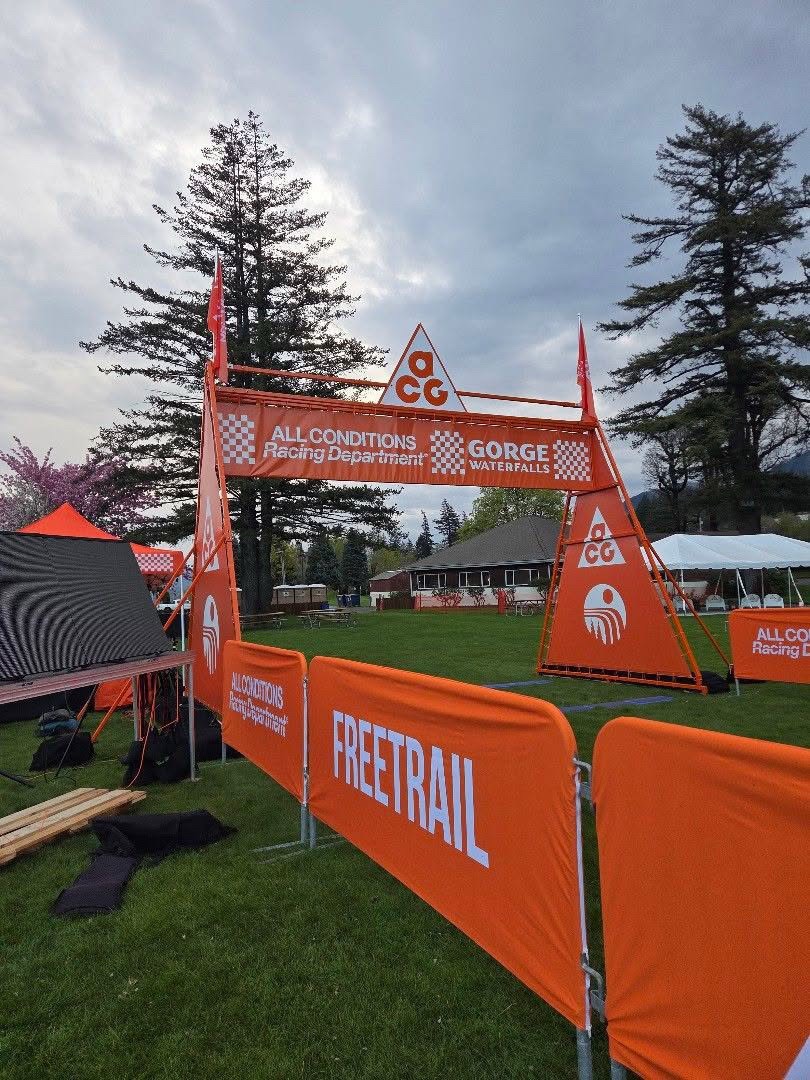
On Friday, April 10, 2026, runners from across the globe arrived at the start line of the Gorge Waterfalls 30K. Many were elite athletes, chasing newly introduced podium prizes. Others were familiar faces on the Daybreak circuit, navigating a race that, for the first time, carried an expanded commercial presence.
For the first time in the race’s history, serious prize money would be on the line thanks to ACG, a gear company tied to Nike. That included $7,000 to be given to podium placers in the 30K, $16,000 for the 50K, and a whopping $52,000 in total prize money for the 100K.
For any trail race, this is substantial money.
When announcing the deal, Freetrail said:
“One of the largest prize packages in the sport globally, this is a major investment in professional racing and the livelihoods of professional athletes.”
Elite athletes took notice. The 30K and 50K race slots filled up with arguably the most competitive lineup in Gorge’s history. Both races featured multiple runners who participated in the 2025 World Championships, athletes who have podiumed at Western States, course record holders of recent golden ticket races, and even last year’s OCC women’s champion.
These athletes would have been hoping for equal access to that prize money, and everything that comes with a spot on the podium.
In this context, equal access would mean all athletes have the chance to compete under the same conditions.
By definition, that isn’t what happened at the start of the Gorge Waterfalls 30K on Friday, and the 50K on Sunday.
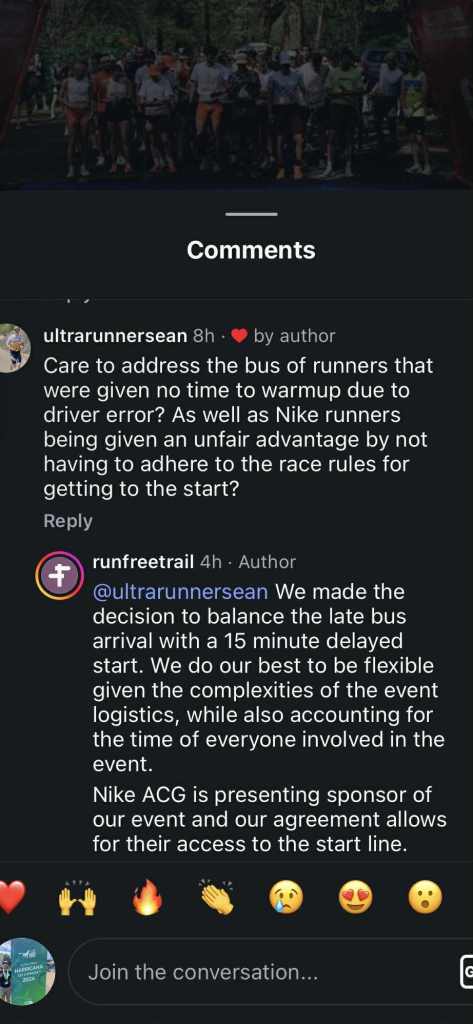
As confirmed by Freetrail on social media, ACG athletes were given access to the start line on their own accord, without having to take the mandatory shuttles to the start.
Simultaneously, the official race website reads:
“All runners must ride the shuttle bus to the start. Runners may NOT be dropped off by car at Wahkeena Day Use for the start due to State Highway Department parking restrictions and ongoing historic road construction project work.”
This has created a disparity.
On the one hand, all runners were required to ride the shuttle buses. Yet the rule was not applied equally across the board. ACG athletes had a private exception to the rule, which was not transparently communicated to the trail running community or the participating athletes prior to the start of the 30K.
The news only came out when multiple athlete reports began to surface surrounding bus delays to the start-line of the 30K. Those athletes arrived within minutes of the start of their race, only to find parked cars and ACG athletes already in attendance.
This continued into the 50K on Sunday. Elite runners have described “hundreds of athletes” lining up to use the washrooms shortly before the race start.
Multiple athletes shared with me that washroom lines still had dozens of runners waiting by the time Wave 1 started. Wahkeena Falls offers limited off-trail space, which may have created additional challenges for athletes attempting to use washroom facilities before the start.
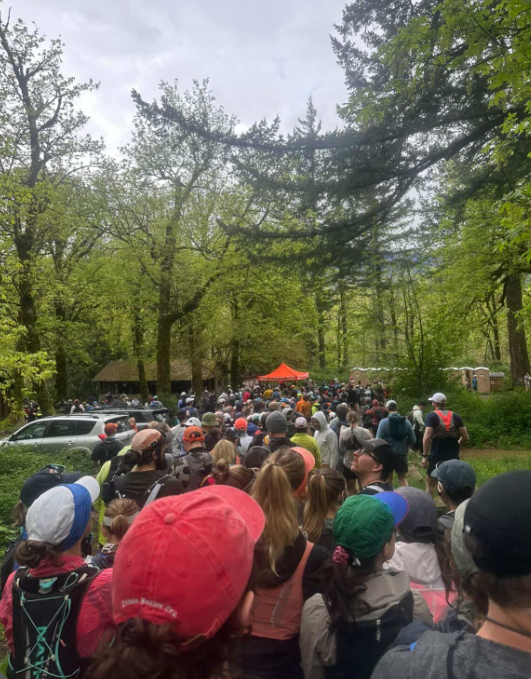
ACG athletes were given the ability to skip these long lines, and warm-up well before any other athletes arrived.
Especially considering the bus delays, elite athletes of other brands had to endure stress that ACG athletes may not have experienced. They had to worry about missing the start of their race. They had to worry about buses arriving late, or getting lost. They had to find space to warm-up within the crowds, find the location for their drop-bags, and use the washroom all in a short time span.
In some cases, they even had to jog over 1km with their gear after being dropped off at Multnomah Falls rather than Wahkeena Falls.
Given their start line access, ACG athletes may not have felt this same level of pre-race stress.
This can be significant, particularly in a blazing fast 30K. Without proper time to warm-up prior to those paces, athletes increase their risk of muscle strain and suboptimal performance.
This raises the possibility that pre-race conditions could influence the results. The chance that an unsponsored or differently sponsored athlete might make the podium is reduced, when some of their competitors had a different window of time to allow their muscles to prepare for the demands of the race’s hot start.
In the 30K, three of the six podium finishers were ACG athletes. In the 50K, ACG’s dominance continued to an even greater extent. The gold and silver medalists in both the men’s and women’s races were from ACG, comprising four out of six of the prize money placers.
In the 100K, two sponsored ACG athletes soared to the podium, plus an ACG employee. Again – three out of six.
| Brand / Sponsor | Podium Finishers at Gorge |
| ACG (Nike) | 10 |
| Unsponsored | 3 |
| Hoka | 1 |
| On | 1 |
| Altra | 1 |
| The Trail Team | 1 |
| Aravaipa | 1 |
It’s also worth noting that 75% of the fourth-place finishers across the men’s and women’s 30K and 50K events were also ACG athletes.
Nike will see this as a success. Their athletes, decked out head to toe in white and orange, have appeared as the centrepiece in over 65% of trail media captured by Freetrail and Daybreak this weekend on Instagram. Much of the other athletes featured are wearing orange or Nike swooshes, or receiving hugs from those wearing ACG clothing.
Meanwhile, 55% of the prize money ACG donated to Gorge with the intention of growing the sport has gone back to ACG affiliated athletes.
ACG’s involvement at Gorge represented a significant level of investment from a major brand into the sport. Race organizers, however, are typically expected to ensure a fair and consistent experience for all competitors.
Beyond the issue of fairness, there is also an issue here of transparency. Daybreak’s agreement with ACG over their start-line access has not yet been communicated to the trail running community at large. I reached out to Daybreak for comment on April 10. For now, all we have is the response that Freetrail gave to a commenter on Instagram.
Historical precedent in trail running has shown us that issues of fairness are unlikely to change without enough public scrutiny.
For other North American majors coming up in the months ahead, from Canyons to Broken Arrow, the events of Gorge have given race organizers much to think about in managing their sponsorship agreements and obligations. It remains to be seen whether any changes follow.
For now, the incident is likely to remain part of a broader conversation around fairness and transparency in professional trail racing.