
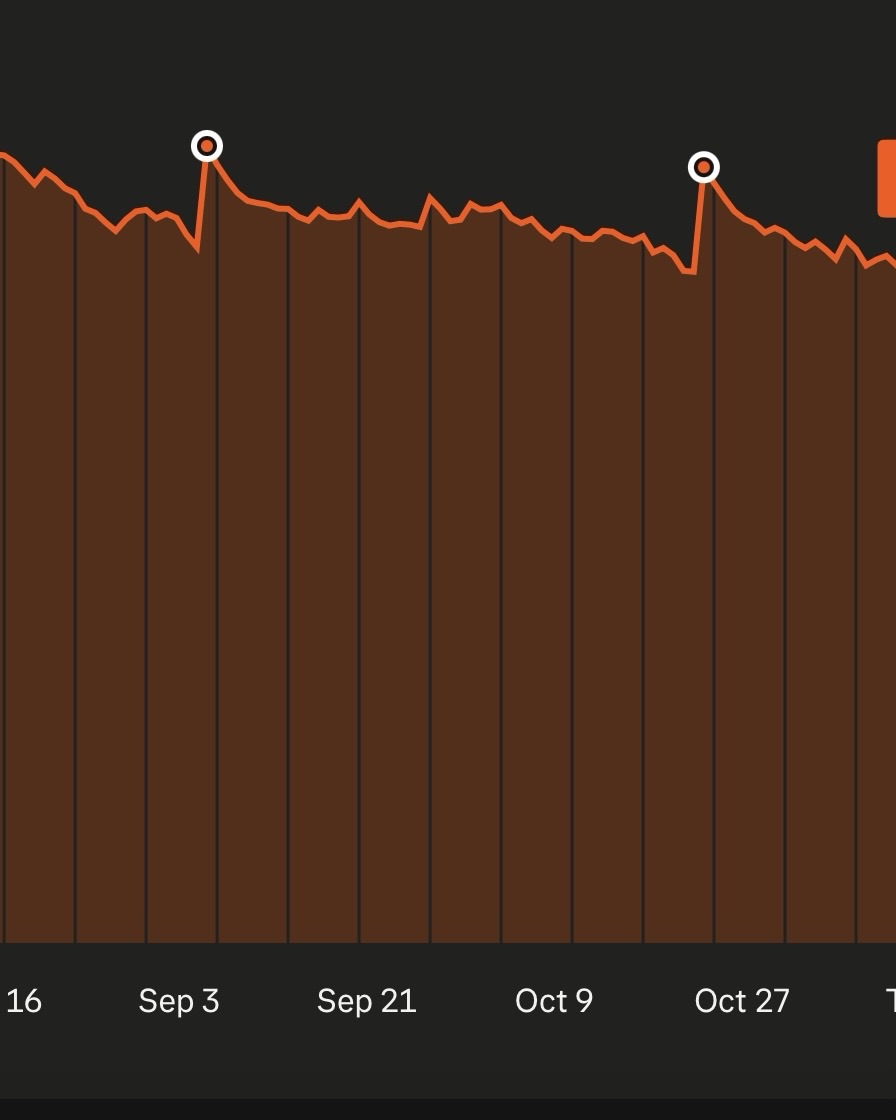
Recently, I’ve noticed a wonderful trend with my fitness.
My heart rate has continued to lower by the month, both on easy runs and workouts.
Faster paces are more manageable than they’ve been since my university days – an environment in which you’re thrust into three workouts a week.
And I’ve started to notice that on days with dedicated speed work, I’m able to average around the same heart rate across the clock as a used-to-be easy run.
Yet Strava has continuously shown a downward trajectory in my “Fitness”.
It’s easy to see that this isn’t correct. But you might not know why if you’re not aware of how Strava compiles their scores.
So with that, I wanted to show you what metrics matter on Strava, and which to (almost) completely discard.
FITNESS ❌
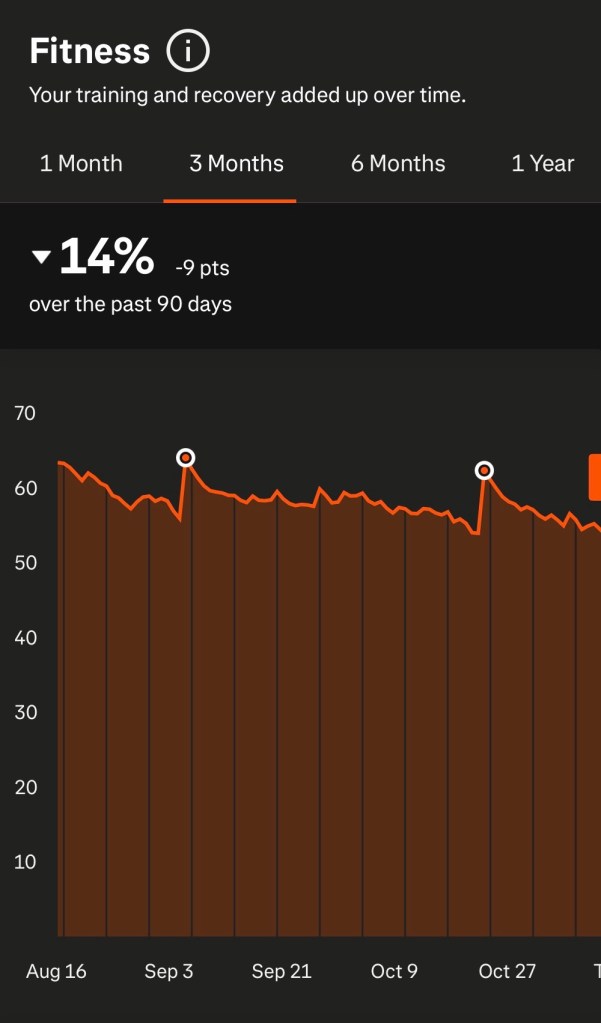
The Strava fitness score is a hoax!
And here’s why….
Strava’s Fitness score only increases on days where the heart rate is stressed beyond your average day.




If you’re constantly running harder than you should, you will consistently see this number increase.
But as I’ve written about in Are you running too fast?, fast and hard running really should be reserved for speed work.



Most of the work you’re doing should be easy, causing minimal stress to the body.
Under a typical training approach, you shouldn’t expect the ‘Fitness’ score to deviate much. It might go up after a workout or challenging long run, stay the same on an easy run, and then decrease again on rest days; levelling back to normal.
Under an approach where someone might race every single week and break their body beyond reason, their fitness score will inevitably rise through the roof.
In other words, Strava’s ‘Fitness’ score actively encourages poor training tactics.
Real fitness actually comes when you can keep your heart rate down at just about any pace.
When you have your heart rate on a workout equivalize to what the average person gets up to on a walk.

The fitter you actually get, the less you stress your heart rate on any day of the week.
Therefore, this Strava score is actually the opposite of what real fitness looks like; hence why scores go down with noticeably better fitness.
So what metrics should you care about?
RELATIVE EFFORT ✅
Instead of scanning for those ‘Fitness’ boosts, every Strava subscriber should pay more attention to their ‘Relative Effort’.
The Relative Effort score looks at heart rate data to discern how much of a toll each exercise takes on the body.
A higher score = more toll. A lower score = a higher likelihood for better recovery.
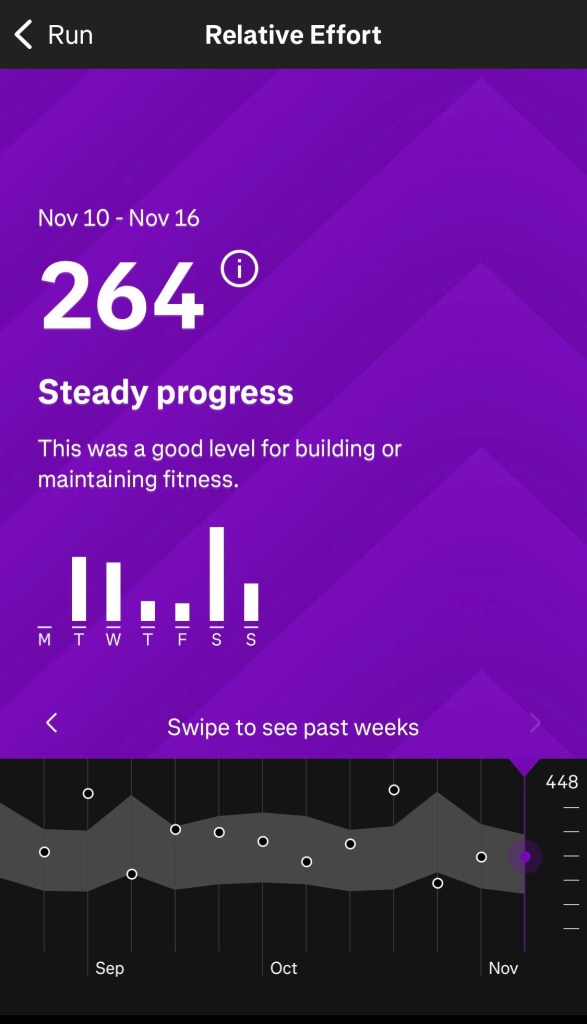
Like any good training regime, there should be moments where the body is stressed, and others where the body is able to, more or less, relax.
So, super high Relative Effort scores don’t always spell ‘bad!’⚡️.
But as I suggested with the ‘Fitness’ score, real fitness stems from being able to run faster at a lower cost to the body. In other words, at a reduced amount of effort.
So even on workouts and challenging long runs, I find that my ‘Relative Effort’ score rarely gets into the red. Most of my work is done in what Strava colours purple, only reaching red on really race-specific work or races themselves.
You can see from my Relative Effort data that I typically only spike on race weeks, before returning with a down week and then consistent training from there.
Across the period shown, I’ve only had one run in the triple digits, reserving higher numbers only for my two races otherwise.
Typical long runs hit between a score of 30-60, typical workout long runs hit between 60-90, and weekly workouts tend to sit somewhere in between.
That’s because even if I’m out for a few hours at a time, the effort is kept controlled and sustainable, and/or is surrounded by an appropriate amount of easy recovery in between harder spells.
For athletes that feel as though they’re always injured, have a difficult time recovering between runs, or feel like they’re lacking energy, this is a great place to look.
I encourage my athletes to monitor their daily and weekly “Relative Effort” on Strava, and use it as a metric to discover whether or not they’re running their easy days or easy components of a workout too fast.
Beyond that, it’s useful for ensuring high spikes in training are matched with appropriate downtime, both within a week, and on a week to week basis.
PREDICTION TRENDS 🤭
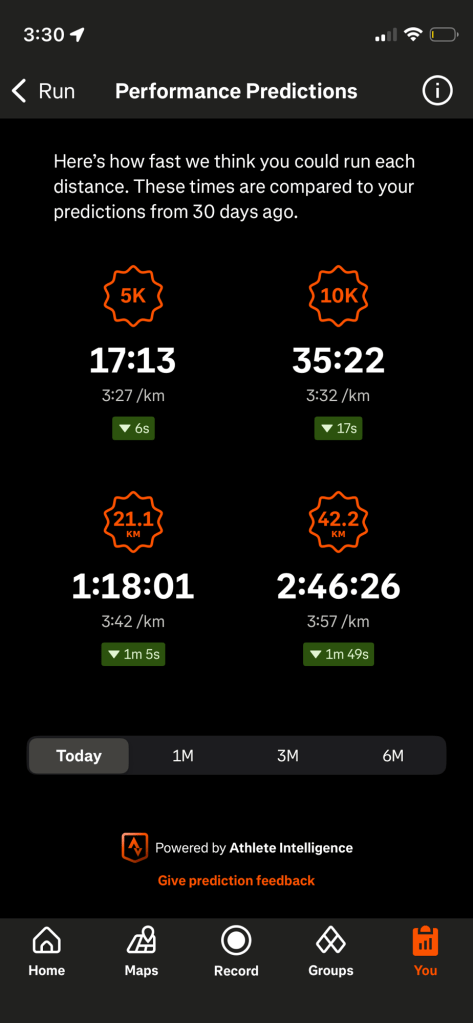
Strava’s prediction trends are, for all intents and purposes, pretty cool.
Runners shouldn’t get too bogged down in the data as an actual predictor toward their capacities and capabilities.
But the predictions have often felt reasonably close to reality for both myself and the athletes I coach.
And unlike ‘Fitness’, this score continues to improve when you run smart and keep your heart rate down, as opposed to only growing when you stretch yourself too far ✅.
I would never use it as an exact science or guide toward setting time goals across different distances (especially because I think they lean a little slower than what athletes are actually capable of accomplishing).
But for runners lacking confidence, I think it can be a useful reassurance, and a way of presenting “proof” toward what an athlete might be capable of accomplishing.
TRAINING ZONES 👌
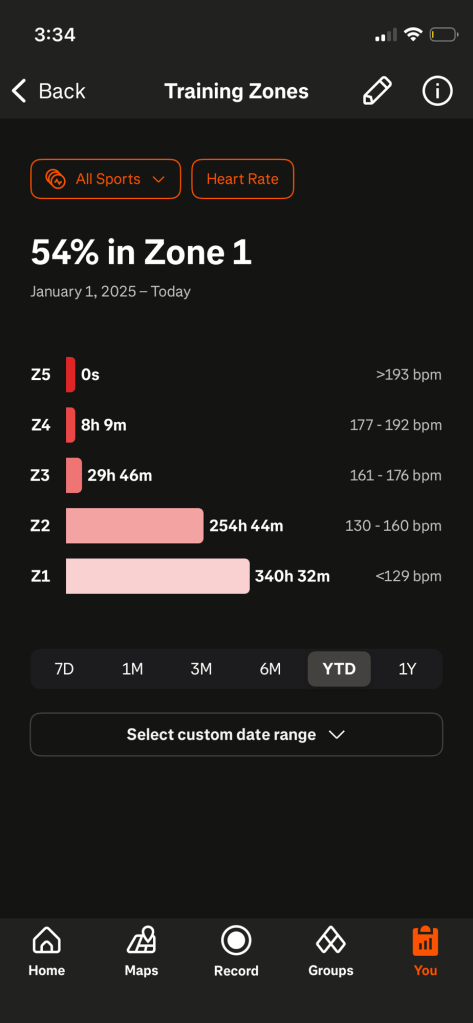
One of Strava’s latest features is their “training zone” graphs, which are great for athletes tracking their heart rate and weekly “easy” totals.
The 80/20 rule is often oversimplified, but for athletes following an approach of 80% easy, they can now more easily identify the actual precentages behind their training.
I’ve spoken about my own heart rate data and this Strava tool in another post – The 80/20 Rule & Analyzing Heart-Rate Zones.
What I left out in that post is that setting your heart rate zones based on “Max HR” is rarely the most accurate way of understanding your zones.
Exact numbers can fluctuate, and extremely fit athletes have a higher threshold for Z1 & Z2 work.
Francesco Puppi posted his data in a Strava promotion, which had his Zone 1 reaching up to an HR of 140.
An athlete like Francesco knows this from dedicated lab testing, which for all of us mere mortals, we don’t necessarily have easy access to.
So when you’re setting your zones and using this tool, recognize that your exact numbers might not be your exact numbers.
You can usually more intuitively tell what feels easy, moderate or hard for you, and go based off both perceived effort and heart rate to come up with that formula.
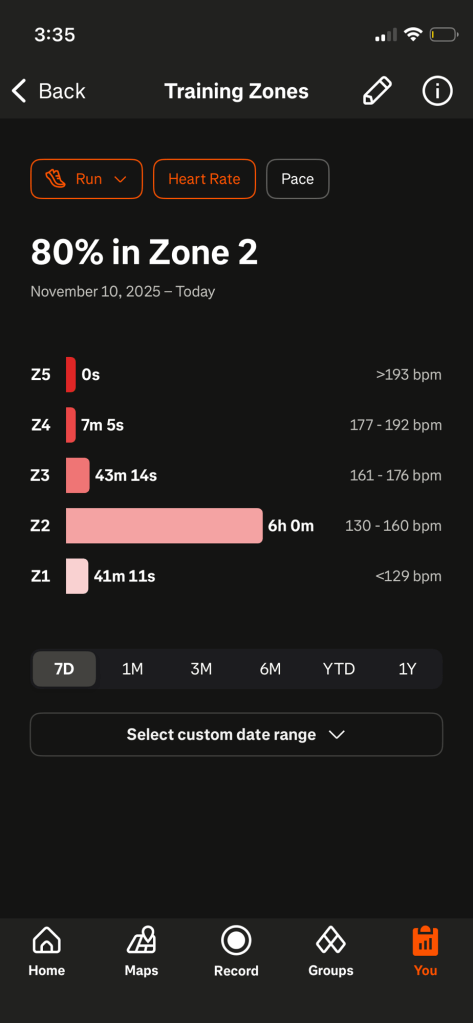
In that previous piece, I wrote – “I find that I tend to be running moderately hard any time I’m exceeding an HR of 135 on downhills, 145 on flat, or 155 on uphills.”
This doesn’t have to be so exact and precise, and can sometimes change by the day. But my main point in presenting this is that all of those heart-rates (HR 135-155) would technically fall within my Zone 2 based on Max HR and whatever else Strava has finagled to lengthen my Z2.
This would all fall under that high percentage of “easy running”.
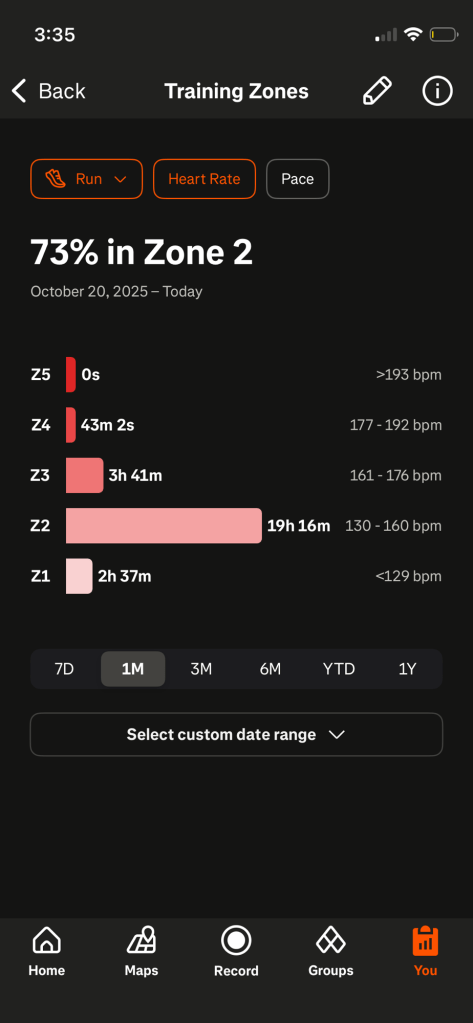
But I’m telling you face to face, or phone screen to phone screen, that all of this running is actually moderate.
I’m also telling you that my Z1 percentages would be higher after a 300$ lab test, when given a more exact number as to how high my Z1 truly reaches. To me, it certainly feels closer to HR 134-137 than what’s graphed.
So while I again think that this is a useful tool to help runners keep their easy days easy and manage their effort over longer periods of time, I also think it can’t be used as an exact science.
What Strava metrics do you like to utilize in your training? & Which do you like to forget? Be sure to reach out for coaching advice or for help interpreting your data. Thanks for reading and see you soon!







 Rhys Desmond