I don’t know what it is with my body.
Why it always chooses the week of a race to get sick.
Training has gone pretty great this year. Then I enter the race on cold medication and Advil, having been coughing and sneezing all week.
With symptoms showing up exactly one week before, I knew I had a week to rid myself of the cold, and stay positive toward what might be possible come the race.
I like this quote I put out on Strava because I think you can apply it to a lot of things in life.
“I’m trying not to hold myself back by making assumptions about what I can do.”
I think we’re often too quick to assume how something is going to go, before fully going after it and trying. And even when I felt like death leading into QMT, I’ve never let the doubt rule an attempt.
I came into the race as I’ve approached each this season, with wonder and an openness toward what might be possible on a good day. Coach Jade uses the word “curiosity” with her races, and I really like that phrasing as a way of shifting attention from outcome goals and focusing more on possibilities.
Like my past few races, I didn’t set any time or place goals (although I always have a rough frame). Even more so with being sick, a time goal would be tough to say, given that I wasn’t quite sure how my body would react and respond on the day. When it is bad enough, you can suddenly just stop working. That’s what happened to me at QMT in a much longer race. Like every fibre in my legs was just like “stop.”
And while I knew a slow-up wouldn’t be as drastic in a half marathon, I knew a slight little slow-up could be totally realistic as the race wore on.
I’d also had a few cracks at what intuitively felt like half marathon pace in training, and it often felt difficult to maintain after about 3K. My assumption was that with a proper race taper and continued fitness boosts going into the race, that 3:35-3:40/km would be attainable. Maybe even faster if all the stars aligned.
But I think what I find with any race right now is that I’m quite happy to settle for what feels hard enough, without wanting to feel like I’m breaking myself, or at risk of breaking myself.
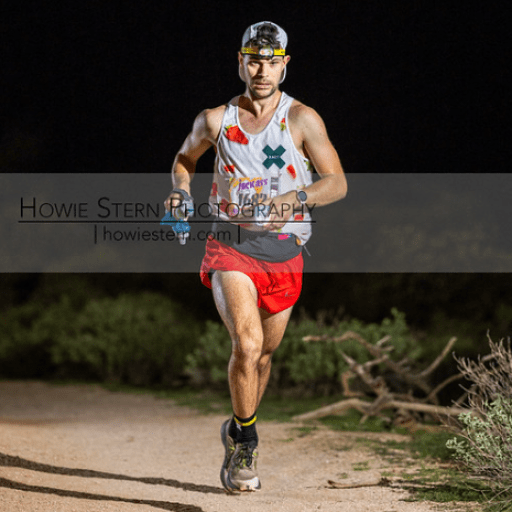
Within two minutes of Javelina’s Jackass 31K I had finished fourth, settling for what I assumed I could do.
Even in long run workouts hitting 3:35/3:40/km several times in a row felt like I had to stay really in it. My body naturally wanted to hover between 3:40-3:50/km, and I constantly had to tell myself to go faster and to speed up at the 3-minute-mark to hit the split.
And as much as I don’t care to compare myself to others or past versions of myself, I know that I’ve run a 1:17 before (albeit 8 years ago), and that many runners who do very comparable things to me on trails run a whole lot faster than that.
It doesn’t bother me. I went into trails for exactly this reason. Flat, fast running just hasn’t ever felt like my strength.
I would say this is the first year in eight where I’ve even felt like a “fast” runner at all. Shuffling up and down mountains not only feels more fun for me but also a better fit for my capabilities.
At the same time, I also very much subscribe to the speed equation of ultra distances. The faster runners in a 10K or half marathon can often be the faster runners in a 50K or 100-miler.
So to eventually get better for 50K distances and beyond, I’ve really looked at this year as a way of growing my speed back again and getting more efficient at running well, and running economically.
It has worked great thanks mostly to Coach Jade and somewhat to my Ron Burgundy teleprompter reading. I might have been around 1:15-1:17 on a dream day and able to hit that PB.
But it just wasn’t the day. That feels disappointing, but sometimes you can only run the best that you can. Or the best that you can convince yourself to go. And I think I have learned from this one in terms of how hard I can convince myself to go, helping to trust my fitness and push harder in my trail races next season.
THE RACE
The race started like any other for me, positioning myself at the front of the front-line, and accelerating well to get into a good early position.
You guys that are running 3:00/km just to sit in the second row at the gun, what are you doing?!
I felt really relaxed running fast for the first few kilometres. It felt controlled and not out of touch with reality. It also wasn’t too far above my desired pace, so that gave me some confidence that I was in a decent spot.
Pretty quickly, the runners able to run at that pace in their HR 130’s escaped, and I focused on my own effort as the distances widened.
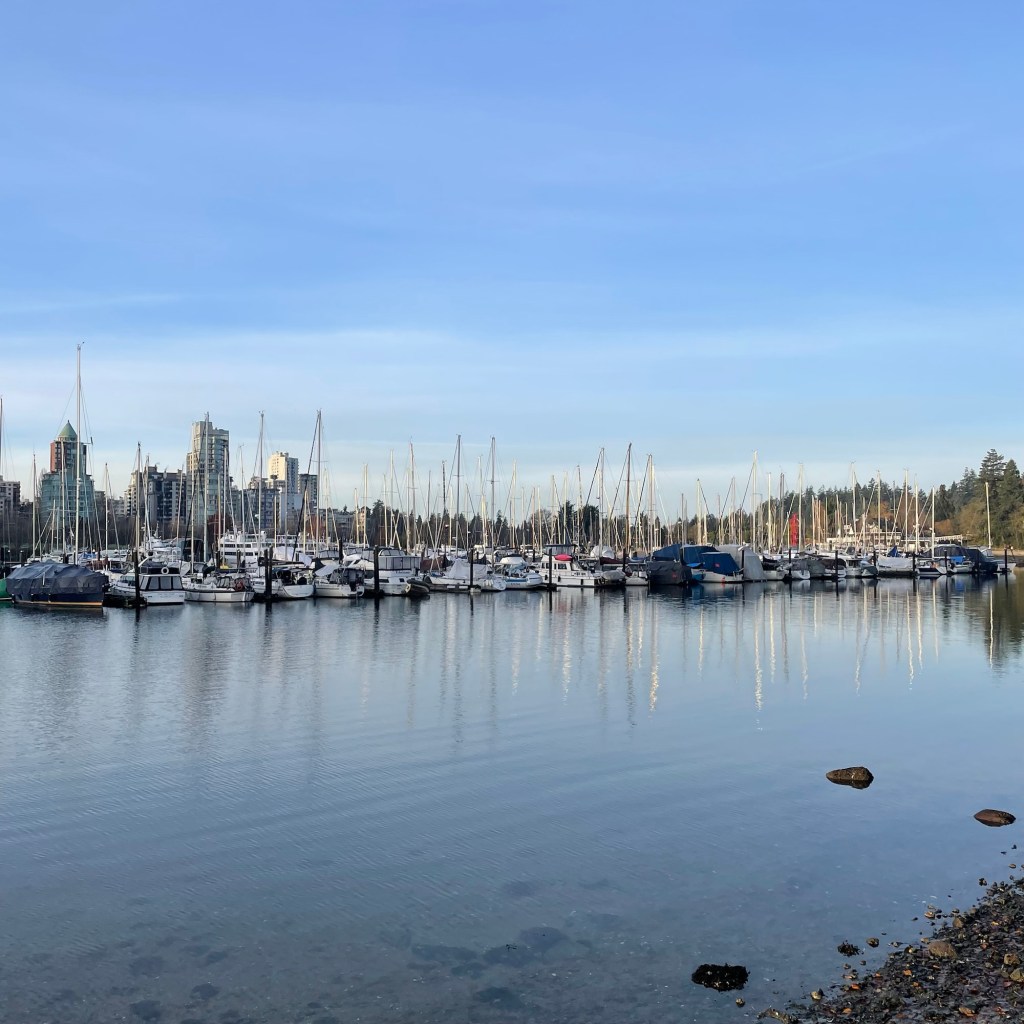
After a few k I settled into that sort of dream pace, around 3:36/km, and focused on my foot placement across the turns of the Seawall. I focused on picking a good line to avoid the public, and felt almost at ease with the foot pounding coming from behind.
We hit a tight little turnaround at 6K, interrupting the rhythm a bit, and I continued to carefully watch the direction of the runners ahead.
I didn’t know the course very well and it wasn’t just a succinct lap around the Seawall.
I felt slightly disappointed that I had let my split at the turn marker drop down by almost ten seconds, and felt happy to hit the next one right back on pace. Around that time, another runner made an attempt to pass me… on an uphill.
There was only one tiny hill in the entire thing and you best believe I was not going to be passed on the most fun part of the course.
Realizing that I was barely breathing at all against the sizzling oil, I took the immediate downhill that followed at a decisive pace. Despite feeling really strong, the curvatures of the path and the focus on the public likely took up more mental energy than desired as my brain already started to naturally tire, making 3:36-3:38 more difficult to maintain.
The runner behind made a more decisive move this time on the flat toward the end of the first lap, leading me for a few kilometres. When I saw him reaching for some kind of gel or something in his back-pocket, I then made it my moment to surge back ahead and regain the lead.
I again felt really strong but my pace continued to slip. Mental energy had to be expended a few times to let people know I was coming, and I had to calculate when I would take the inevitable gel that the other runner abandoned himself when I caught him.
I told myself that I would likely be able to push with 3K to go, and I wanted to wait until that tight turnaround to increase my pace back into a mode where it felt like I was having to reach to run fast.
But whenever I reached to run faster I could only convince my muscles to do it for a few seconds before returning back to the 3:45’s.
A little surge after the turnaround meant that I wasn’t concerned about anyone coming up behind (although I would have welcomed it and it likely would have made me run faster).
As I approached the only fun little uphill, I shifted my attention to the runner in yellow up ahead. He seemed to have a 30-second gap on me, but when I hit the ‘3K to go’ mark and decided that I was going to ‘go’, I felt like I was making subtle progress, even at 3:40/km.
With 2K to go the runner in yellow suddenly became three runners in yellow (not a hallucination, I promise), and I guess I let it bother me a bit that the guy with unofficial pacers had now been able to pick up his own pace.
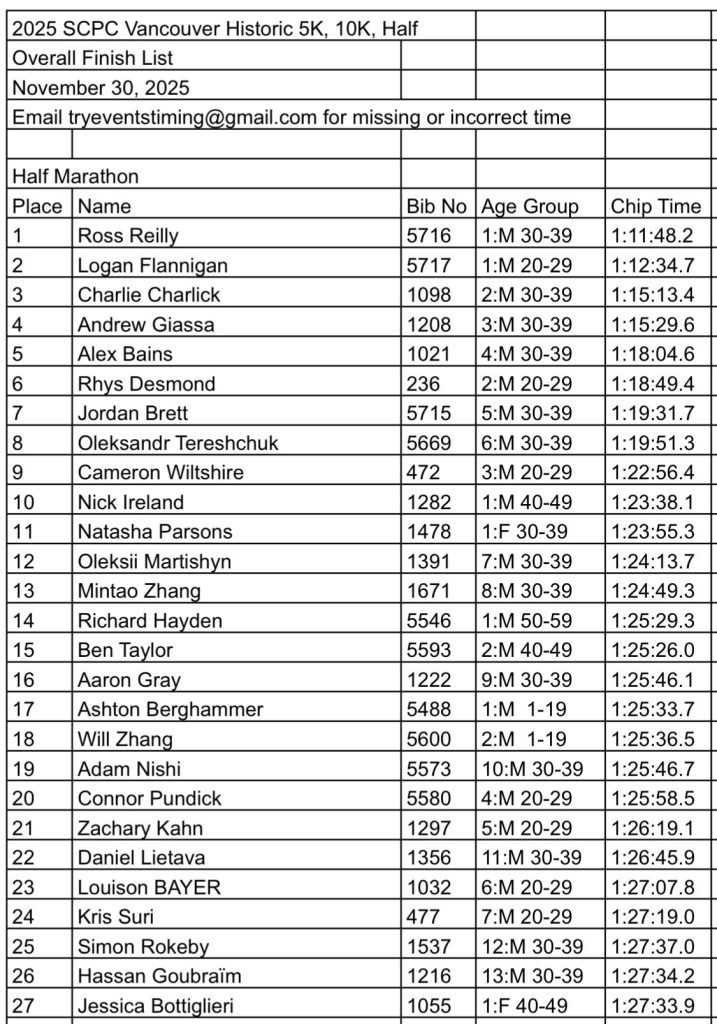
I continued to focus on my own finish and tried to finish as strong as possible, still unwilling to break myself to go as fast as I could. When I turned the curve toward the finish line hill and saw 1:18 something, I was pleasantly surprised that I had managed to run so fast while sick, and felt satisfied enough with the performance.
I think it’s tough racing sick but I also think I need to continue getting better at racing in uncomfortable states. If I really badly wanted a PR today and cared enough to really badly go for it, I might have been able to do it even despite being sick. I think I just often lock into what I think will be satisfying enough without wanting to risk too much.
Nevertheless, I did push harder in this one compared to Javelina and Duchesnay, with an evidently higher HR and effort. I think that should be helpful if I can remember that I’m capable of that kind of effort when assessing risk at longer trail races in the future.
For now I close the year with no podium finishes, no super ‘A’ grade race and not the ultimate signal of where my speed and fitness has been this year. But with lots of excitement and lessons learned for returning to the trails in 2026.
I think I need to find that balance of really going for it and setting that goal of finishing on a podium or running a fast time to get myself more motivated to push, with this same approach of wonder and “curiosity” still in place. I don’t need to be outcome dependent because I think it’s often a recipe for disappointment, but perhaps leaning a bit more into outcomes again will inspire me to reach outside of my comfort zone for longer.
At the very least for this one, I’m super happy to see how efficiently and smooth I ran both in how it felt and in the data. It’s been a constant desire of mine this year to get more efficient at pure running, and I hope to carry over that efficiency into a different style of race next year.
Thanks for reading and see you soon!



 Rhys Desmond