
As 2025 comes to a close, many of you have already given your racing plans for 2026 some significant and serious thought.
It’s natural to have the ‘what’s next?’ syndrome when it comes to our sport, as we’re always looking toward that next goal.
So before crashing into the new year, make sure to celebrate both the big AND the small wins of 2026.
Now, if you’ve properly done that, and properly reflected on the season that was, then let’s begin planning for 2026!
Here’s what to keep in mind when selecting races for the season.
P.S. this article serves as an expansion pack of an already existing article that you will probably want to read too!
Constructing your racing calendar!
HOW MANY & HOW FAR APART?

I know you. And I know you love racing just as much as the rest of us.
Races grant us some of our most memorable moments of the year, and some of the most impactful experiences in our running lives.

But given the high demand of racing and the cost to your body, racing needs to be kept in check.
For athletes racing 50K’s and above, I like to think that 3-5 races is the sweet spot. A few races of shorter distances could supplement that and possibly even be added to the mix as an additional “training day.”
But you want to arrive to your peak races happy and healthy. Not burned out, fatigued, and having already peaked for the third or fourth race of a six race season.

One of the things that’s been really cool about watching some of the Golden Trail guys and gals the past few seasons has been the ability of the winners (Final and Overall) to peak at the end of the year. Lauren Gregory has managed to do this two seasons running now, finishing first and second in the past two finals despite lower finishes earlier in the year.
Similarly, main man Elhousine has started his season with a second or third the past couple of years, before going on a tirade and winning everything else.
If your primary or secondary goal race is in August, September, or October, we want to have you arriving there still full of life. Not burned out having raced every month to that point.
I encourage my athletes to select the 3-5 races that intrigue them most, building everything around their ‘big goal’ races (usually 1-3).
For athletes racing shorter distances, you can select a few more, just making sure not to have too many in back to back weekends. If racing back to backs, you’d ideally want enough time (ideally 5+ weeks) between pairs of two.
Even Golden Trail athletes will skip out on some of those back to backs to ensure they’re prepared for the races that count.
Elhousine skipped the Asian tour and Austria this season, whilst working to gain maximum points every other race. With enough time to rest between Sierre Zinal in August and the final in October (no ETC or Worlds), he arrived fresher than anyone else.
Athletes like Elhousine have no problem racing in back to back weekends, primarily because they schedule long periods of downtime with little to no racing.
And that leads me to the how far apart? debate.
For athletes going up from one distance to the next, I like a window of five weeks at minimum. At least one week needs to be somewhat of a recovery week; sometimes two. To then only have a single normal or peak week before a taper leaves us with little time to properly prepare or avoid risk.

A minimum of five weeks is also my preferred length of time for shorter races or going down in distance, so that you can schedule enough race-specific training.
If the two races are similar enough in style (elevation, distance, terrain, etc.) that helps. But even at that, every race is unique in its own way and may require a new set of complications and challenges.
A great time window between races tends to be 8-12 weeks; where you can get in BOTH enough recovery time and race-specific work.
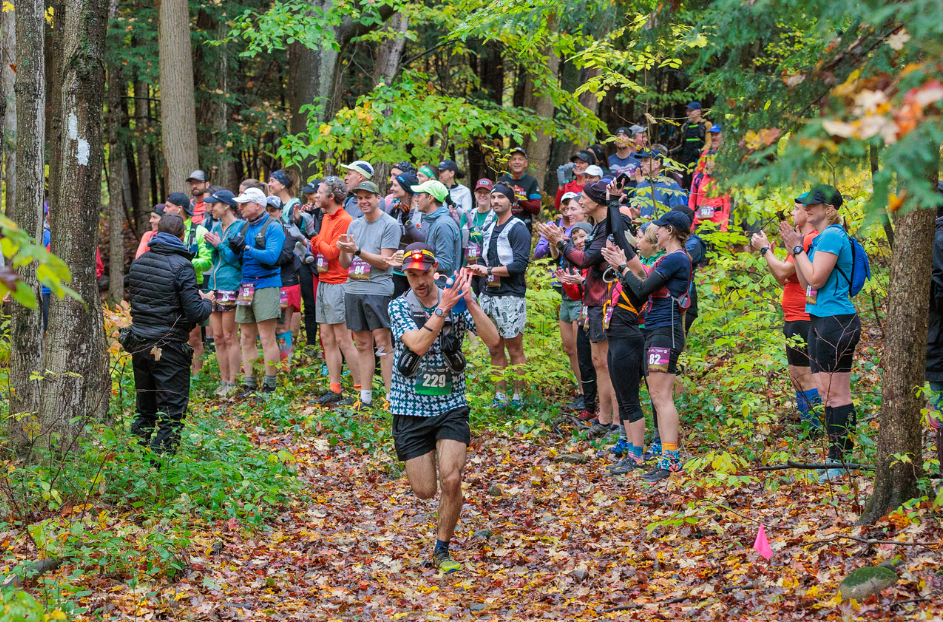
My best race calendar construction so far came in 2023, when I had 8-10 weeks between Ontario’s hallmark trail running events. I podiumed all three, and arrived to each race happy and healthy.

With so many races to choose from, this can sometimes become quite the difficult task. But at the very least, a time window of 8-12 weeks is ideal between two ‘A Goal’ races.
SELECTING YOUR ‘A’ GOAL RACES

One of the best ways to decide upon your racing calendar is to work backwards from the end.
What do you hope to accomplish this season?
What do you want to be the season finale?
Is there an additional mid-season race you want to prioritize?
What 2-3 races do you want to make the ‘focal point’ of the year?
Once you know what races will be your top priorities in 2026, this can then guide the remainder of your race selections.
If your goal race is a trail 50K, it’s often best to get in a trail 50K; or at least a 30K beforehand.
You can learn a lot from racing an “easier” 50K or a shorter race, before a longer, more intense one. Specifically, you know what it feels like to cover the distance and the relative time on feet. Much better, I might add, than trying to do this in training.
If your goal race is a crazy 100K, selecting a similar enough 50K or 50-miler would be helpful.
If your goal race is all the way up to a wild 100-miler, a 100K or 50-miler would also be a great practice race.
Bottom line: You need to give yourself enough exposure to the distance as possible, without going overboard in the week to week, day to day of training.

Races are often the best way to do that, as we can decrease volume toward a race, allow for some recovery, and then ramp back up safely.
In guiding that process, you should really only have 2-3 ‘goal’ races in a calendar year. Anything more means you risk burnout and/or lessen race-specificity.
Anything less may also mean that you put too much emphasis on one singular day, which can so easily fall apart and leave you unsatisfied.
I experienced this with QMT 50K this year. Every other race in my 2025 season would be shorter and naturally less to compartmentalize. But with this one being Nationals and the only 50K, the pressure of performing to specific markers overrided the experience.
So make sure to select your goal races early, and think about how the entire season can serve those events. If you need help doing that, I’m always here.
Thanks for reading and see you soon!








 Rhys Desmond