

If you’ve consumed any endurance content within the last few years, you’ve likely heard about the ‘80/20 rule’.
The theory is that you should be spending the majority of your time in easy heart rate zones (i.e. Zone 1 and Zone 2), and very little time in harder heart rate zones (Zone 3 – Zone 5).
For reasons outlined in articles like this…
-> Weekly Newsletter – The benefits of strides
-> Weekly Newsletter – Are you running too fast?
This approach will achieve the best outcomes for your long-term development.
Short story short – You can gain all the necessary fitness and muscular gains, while giving yourself plenty of time to recover for the next effort.
If you blast yourself into the volcano every time you go out, you’ll either end up exploding right back to where you started, or too fatigued to actually continue to perform well across an entire season.
Not to mention that if you’re training consistently enough, you should rarely ever reach Zone 5. Let’s start here…
ZONE 5 SHOULD BE A RARITY
Reserved only for the final kick in races under extreme circumstances, Z5 usually can’t even be reached when we go up to a “10” in VO2 max efforts like 1-minute or 2-minute hills in training.
Your body simply doesn’t want to get to this state. When we do, it takes a lot out of our heart and muscles.
We therefore never train at maximum capacity. That “20%”, should only really be rooted in Zone 3 & Zone 4.
The usual approach is then to make up the remainder of that 80% into Zone 2.
But, for many reasons, you can’t forget about Zone 1!
DON’T FORGET ABOUT Z1
It’s well studied that professional and elite athletes spend a higher percentage of their time in Zone 1 than other athletes.
This is consistent across all Olympic sports.
And even though our sport takes a higher toll on the body, it’s true of runners too.
Pause. I know what you’re thinking.
And… you’re right. These athletes are freaks of nature. They’ve trained their bodies over years to withstand significant demand. What feels impossible to most, feels easy for them.
You’re right. It’s not always intentional. They are just that good.
But elite athletes also spend more time in Zone 1 incredibly intelligently and intentionally. They…
✅ Tend to be intentional about the desired outcome of each training day, thus remembering the scope of a training day within the scheme of an entire week or block. They therefore don’t get caught up with ‘in the moment feelings.’
✅ Usually adopt more discipline in sticking to safer approaches, typically under the guidance of a coach.
✅ Utilize multiple training tools to create a greater breadth of volume (i.e. cross training, doubles, more days of the week, etc.), and therefore more of their training has to be in Zone 1 to avoid risk.
And as you train toward your own races, you will build incredible fitness by spending more time in Zone 1, while training smarter in the process.
It doesn’t mean that we don’t then get up to Zone 3 and Zone 4 and incorporate tons of speed work and “harder efforts”.
It just means that this is the cherry on top and a nice dessert to the full meal of training we do otherwise.

If you’re unsure of where you stand, Strava has just come out with a new feature that shows you exactly where you stack up within your heart rate zones. So let’s take a look at an example from my own training across the past three months.
MY EXAMPLE DATA

Since the day after Quebec Mega Trail 50K (3 months today), I’ve spent 76% of my time running in Zone 2.
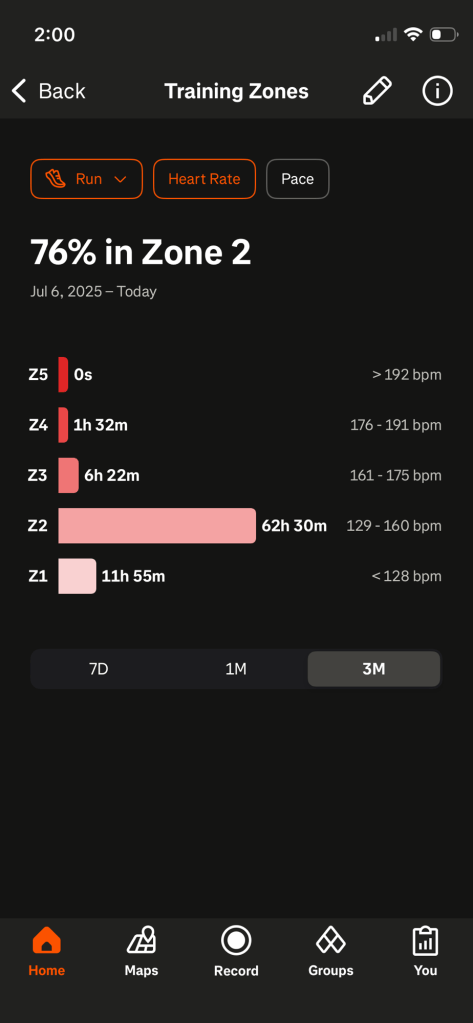
The next percentage of time has been spent in Zone 1, with a slightly smaller percentage in Zone 3 (speed work like strides).
I’ve spent just 90 minutes in Zone 4 (threshold work) across the past three months, and 0 seconds in Zone 5.
This includes one race – Harricana’s 28K, where I spent 90 minutes in Zone 3 and just 20 minutes in Zone 4 across a 2.5 hour race.
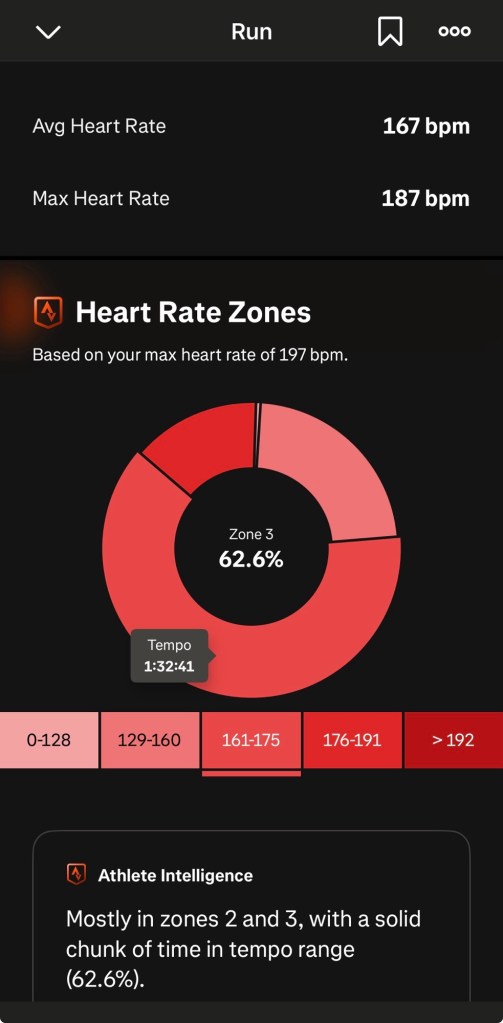
I would describe this as an “all out” effort, yet only 14% of my time was spent in my threshold. For the sake of conversation, a larger percentage was spent in what could constitute “easy”.
Now part of this is because Zone 2 is a massive zone.
Most of that “easy” time was actually spent at a level that I would call “moderate”.
A level that I rarely get up to on easy runs in training. And a level that was also taking a toll on my body – being mostly downhill, or flat but technical.
This provides even more evidence for why Zone 1 should be a door you unlock more often across your easy days.
The bulk of Zone 2 & Zone 3 work is actually moderate, with Zone 4 being hard, Zone 5 being nearly impossible, and Zone 1 being easy.
You can see this even within my pacing data (only available within a 7-day span).
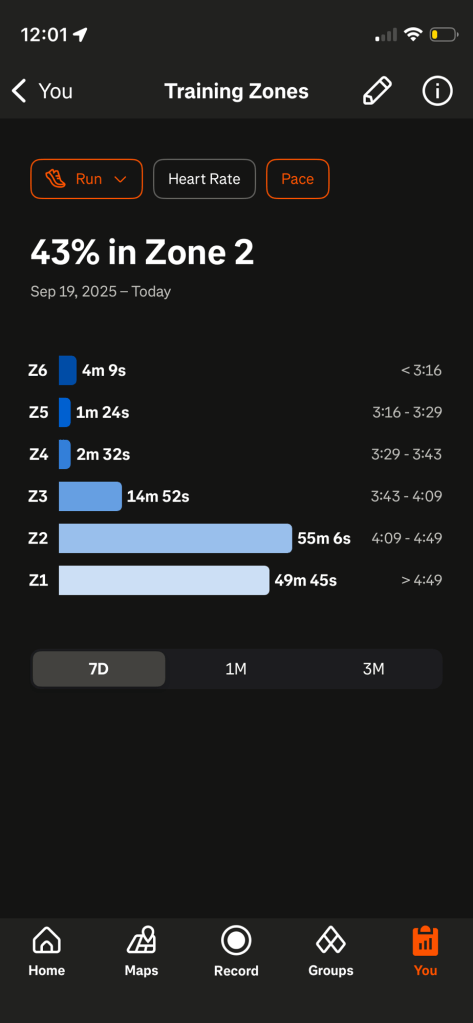
I don’t know about you, but 4:09/km rarely feels “easy” for me except on downhills. Even then, it’s more likely to be a “moderate pace” and a cost to the body even if the “effort” is low.
So even within Zone 2, I’m constantly dialling back my pace to truly exist in an “easy” state.
I find that I tend to be running moderately hard any time I’m exceeding an HR of 135 on downhills, 145 on flat, or 155 on uphills.
You can justify to your coach that it’s easy, because it’s Zone 2. But you and I both know it was more moderate than easy.
Racing data provides plenty of evidence toward this.
When I’m racing, I spend a ton of time in those moderate ends of Zone 2 to be able to sustain my efforts for the long haul. The bulk of time then comes in Zone 3 – at what’s referred to as “tempo”. In other words – race effort. In other words, moderately hard.

When you look at other training tools in my arsenal, it’s almost entirely within Zone 1.
This is one of the massive advantages to incorporating more cross-training into your weekly routine. You can build a higher degree of volume all at safe efforts, at a lower cost to your body.
Weekly Newsletter – Being intentional with cross-training!
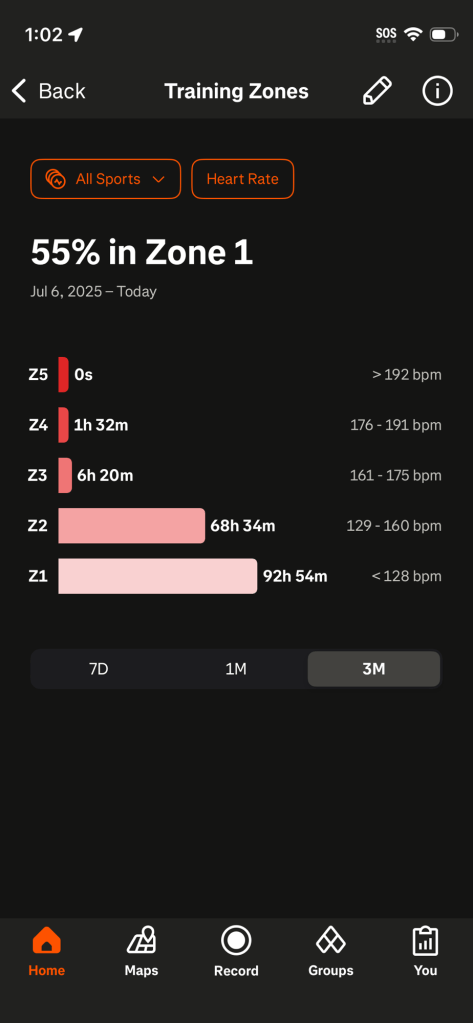
As you can see, none of my cross-training reaches Zone 4, even on speed workouts.
The demand on the body is far lower, and it therefore becomes noticeably harder to push past your cardiovascular comfort, even if it feels like you’re going “all out”. That’s one of the magic pieces to the puzzle of cross-training.
To get super specific, here are the numbers from my four favourite forms of cross-training across the past three months.
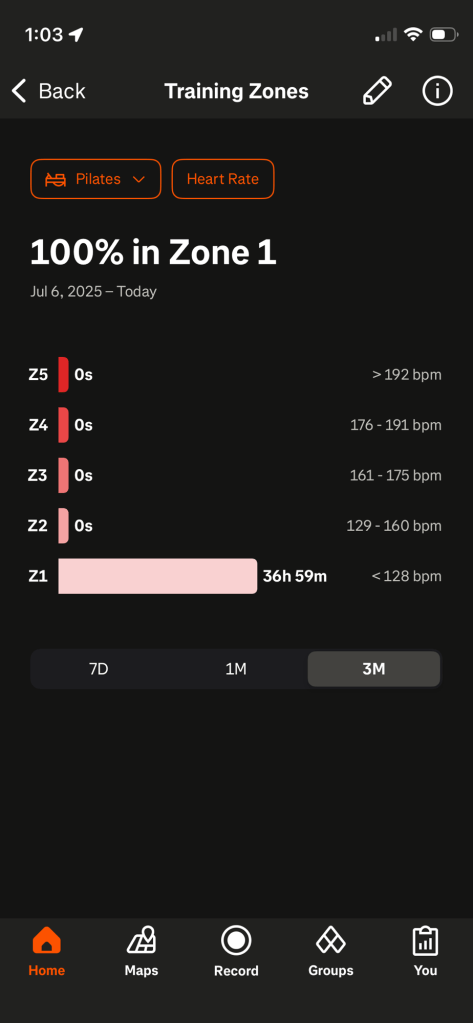
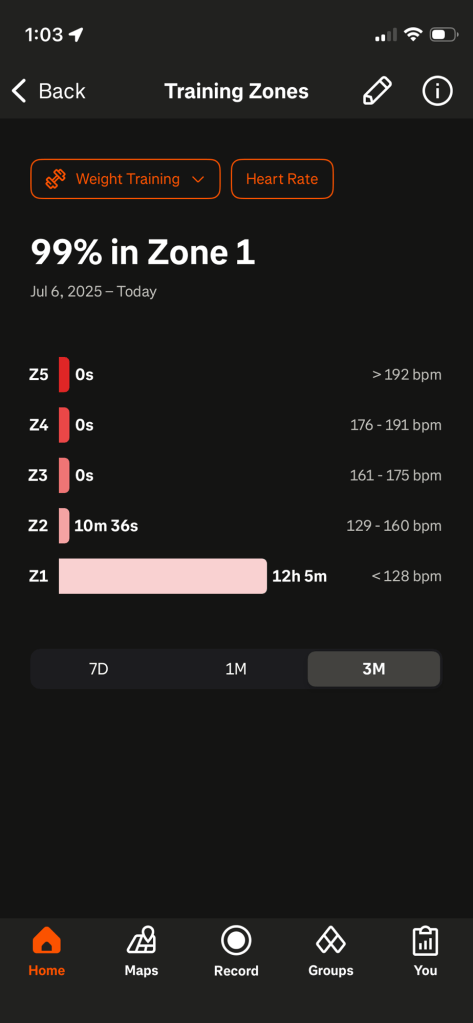
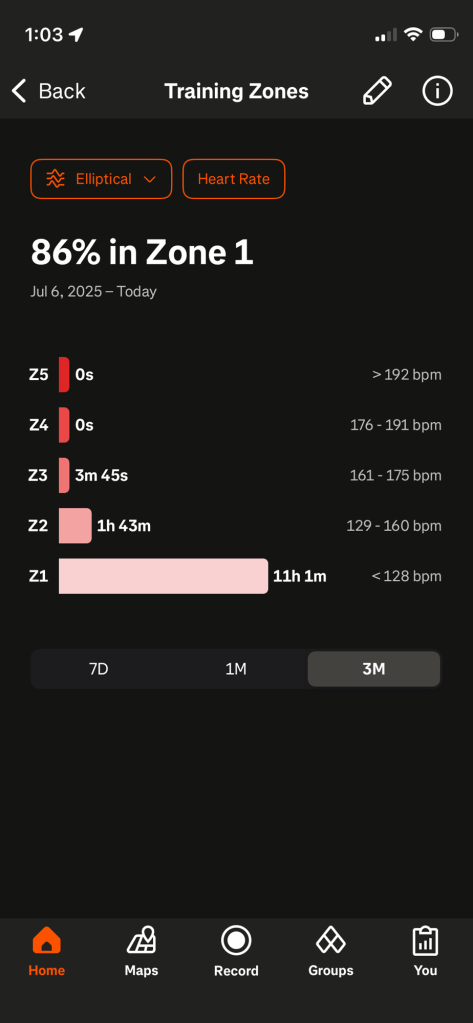
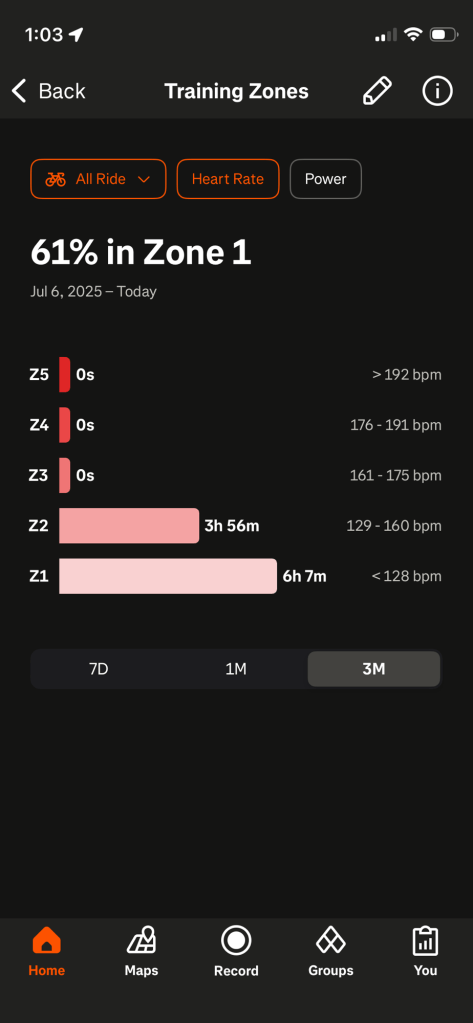
As you might notice, even when I’m pushing on a bike or elliptical (arc-trainer for the win!), I’m rarely reaching for that dessert.
That’s partially intentional (cross-training should generally be easy). But also because it’s practically impossible to push that hard. The amount of power I’d have to put out would be the perceived equivalent to Zone 5 on a run.
And so again, cross-training is a miraculous tool for building volume in Zone 1 and Zone 2, especially if you find yourself struggling to slow down on your runs.
So if you haven’t had a chance to check it out for yourself on Strava’s premium subscription, go take a look at your levels and see where you stack up!
If you want help analyzing your data, feel free to send me the screenshots and the numbers. In the meantime, remember to keep your easy days easier, so that your hard days can be even harder.
Thanks for reading and see you soon!









 Rhys Desmond