I’ll tell you right off the top, nothing I say here will be groundbreaking. This article is meant to show you how simple video analysis can be, even at the high-end level of sport. Yes, you have to know the game. Yes, you should know how to positively promote other people. It even helps to know how to game-ify conversations in order to make them more intriguing. But ultimately, you can easily follow my steps here for conducting optimal video analysis for professional players. Steal it. Take it with you. It’s yours.
Here is my process for creating actionable insights for pros (or semi-pro players) to take back into their own environments.
ESTABLISHING THE FOCUS

As in any coaching environment, we begin every session with a dedicated topic. Often times I’ll choose the topic based on the player’s own ideas. That might range from…
– Off-the-ball movement
– Defensive positioning
– Defensive 1v1’s
– Attacking 1v1’s
– Decision making in the final third.
– Etc., etc., etc.
Since players spend so much of their time off-the-ball, this is usually where I’ll prioritize my analysis. Most event data centers around ‘on-the-ball-actions’, so sometimes you have to get creative in searching for ‘off-the-ball’ events.

But I’ll also dedicatedly look into the data, scanning for both the strong points and areas for improvement in a player’s game. Data points that spike ‘red’ (i.e. well below average in comparison to their peers) are usually worth detailed scrutinization.
But more broadly, for the first couple of meetings, I like to prioritize aspects of a player’s identity that are most essential to their role. Especially if they did not perform to the level they might have been expected to. For example, take a defensive midfielder that is meant to be a bit of a destroyer. If the data tells us that they did not win a high percentage of their defensive duels, tackles, or pressures, I’d want to dig deep into the video to uncover potential reasons why, so that we can help that player perform better within the scope of their specific role. This is where the video analysis enters the frame.
VIDEO ANALYSIS
Once I’ve established the context, I’ll then turn to Wyscout event data and select the specific playlist items worth watching. For example, in understanding why a player did not create many chances over the course of the season, I may not only want to look at their ‘key passes’, but ‘crosses’, ‘off the ball movements’ and other event data that could elucidate decision making in the final third. Looking only at those ‘key passes’ won’t tell me much, as it will likely only showcase a few moments of their final third brilliance and none of the context into why they rarely found themselves in positions to create more of those magical moments.

Throughout this process, I’ll also keep an eye on their ‘best actions’ almost regardless of the topic (often revisiting them several times). That way, I can always filter for the best clips possible, and include those in my analysis whenever relevant.

As I sift through video, I’ll then look for key moments of decision making – whether that be moments that illustrate quality, or moments where the player would probably want the situation back. In particular, I scan for moments that elucidate decision making around ‘BOTS’ (ball, opposition, teammates, space) within the chosen topic.
RELATED: How athletes can improve their scanning and perceptions of BOTS

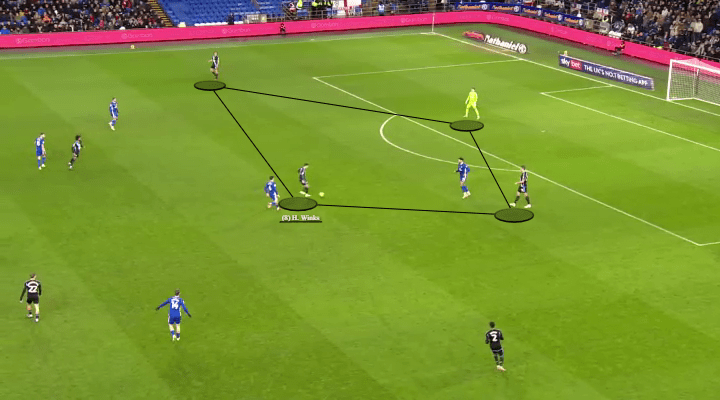
I’ll typically collect about twenty clips for an hour long meeting, including one-two telestrations per clip where the play is temporarily paused at a specific moment in time. As I’m creating the telestrations, I’ll often be thinking about the discussion points in my head, already preparing for what I want to say about each clip.
I’ll then group and re-order clips in a logical and succinct way based on the way I want the conversation to evolve, and download my playlist for the call.
COACHING CALL
Once on the call, I’ll always start with the human side of the sport. I want to understand the athletes that I work with on a deeper level, including the events of their lives beyond football. Athletes are humans first. Understanding more into the context of their lives can give us great clues into how to uncover the best out of their athletic potential; not to mention demonstrating that you genuinely care about their success.
We’ll then provide an overview into why we’re discussing the chosen topic, and dive into the clips one by one.

More often than not, we’ll talk through the clips as they unfold, with broader Q&A periods around any frozen sections of the telestrations. My goal is to help the athlete think about the game on a deeper level (especially in relation to scanning for ‘BOTS’) so I don’t want to give them all the answers.
Instead, I want them to come up with solutions through the thought-provoking questions I provide. I may even want them to challenge my ideas or provide greater context into each moment. So taking over the conversation or hypothesizing one unequivocal truth would never be wise. Team style of play can often heavily influence a player’s path (and the decisions they make on the field), and so some decisions are not their own, but what they’ve been told to do by others (such as their coach). This is important to note, as it allows us to better understand their environment. We can then make more informed decisions about how to bring out the best in their development within their actual context.
In going through the clips, I’ll try and allow for space to ask questions and gain clarity, often replaying the same clip several times. In fact, after the discussion has ended about a specific clip, I’ll usually play it one final time all the way through so that they can bring all of that new learning back into context.

In offering a unique service that centers around all components of performance, I’ll also aim to build up a player’s psychology. I prioritize positive reinforcement, even when going through several clips in a row that showcase moments of lower-quality decision making. I’ll make sure to provide continuous illustrations around how the player already possesses the skillsets required to overcome those weak points, and provide the exact moments that showcase exactly why (because they’ve done it before!).

I also love to come up with gameplans surrounding how players can have these kinds of discussions with their coaches/managers. Any coach/manager should want all of their players to be hungry to learn. For any coach reading this, you already know the type of player you want to work alongside. Is it the player that feels entitled for more? Or the player that consistently shows up, works hard, and asks questions. It’s the player that can illustrate their learning to the coach, how much they’ve been paying attention both inside and outside of training, and provide a clear action plan for how they see themselves achieving their goals. I help players to navigate what can often be challenging and uncomfortable conversations, ensuring they go about it in a way that will only promote positive feelings back in their direction.
DEBRIEF
Following the coaching call, I’ll provide a link to all the clips via Google Drive, and a ‘Debrief’ over a PDF that summarizes the key reminders from the call. Within this document, I’ll often provide some hidden information that couldn’t fully come out in the call, and links to additional resources on my site worth reading within the topic.
We’ll then set up a call for the next meeting, settle on a new topic, and begin the process right from step one.

So that’s how I conduct video analysis and reports for professional players, or any players that I work with from high school to university/college to pro! If you’re interested in seeing more of this ‘tell-all’ content, be sure to check back soon as I unveil more into my processes that led to success on this site for years. If you’re interested in working with me, also be sure to reach out! Thanks for reading and see you soon!





 Rhys Desmond