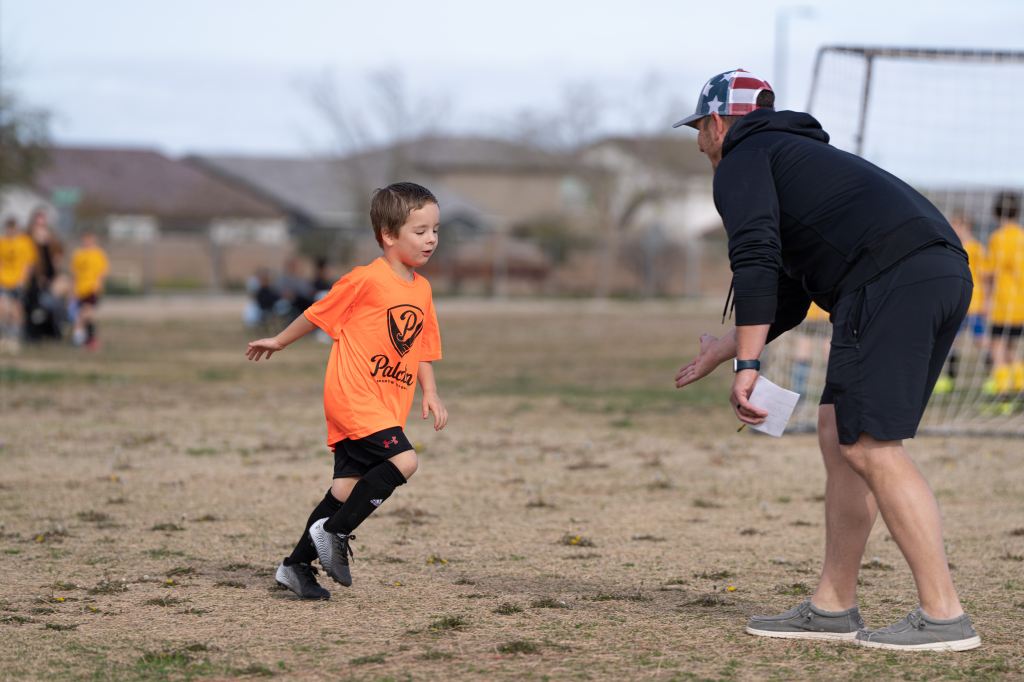
Today I returned to the classroom for my Coaching & Leadership course for eighty+ undergraduate students. For the first class of the new semester, I facilitated a European Handball session on ‘switching play’, which is a session plan I’ve done plenty of times in the soccer world.
Here were some of the key reflections:
LOGICAL FLOW & PROGRESSION

It’s incredibly important for the session plan you design as a coach to logically flow from one stage to the next. This helps athletes to learn in stages, rather than being overloaded with information at the wrong times. The goal is to build in repetition around a few key elements of your session topic right from the warm-up, and allow enough time to practice the desired behaviours, and sport-specific movements/skills.
We started with this activity, where players (at a low intensity) had to find a player in a square, free that player up, take their spot, and then get ready to receive from someone new.

You might think the squares restrict them to a stationary position, but the activity moves quickly enough that they never actually become static. With the right amount of balls for the number of participants (1/2 to 2/3), the activity flows quickly and no one is waiting in the square for long.
Again, the key is establishing repetition around a few of the ideas within the session topic (switching play), and the sport-specific skills and movement patterns that need to be warmed up. We also added a few dynamic movements to ensure all important muscles were properly warmed-up; and conversational elements to increase the social dynamics of the session.
Then we progressed to add in four of the twelve players to now act as defenders. These four hold a pinnie in their hand and if they win the ball, they become an attacker again and give the pinnie back to the player that lost the ball. Adding opposition increases game-realism, and allows for the warm-up to naturally progress in intensity.

That goes on for a short time before we progress one final time to increase all of the demands of the game (except for the typical scoring method). It’s a 4v4 + 4, with the group now split into three teams. We set up with one of the teams in the squares, one as the defending team, and one as the attacking team. The team of 4 that is attacking must free up all of the players in the square by switching play around the area quickly.

Once a player is freed they join that attacking team until it is an 8v4. We time each team to see how quickly they can free up the four in the squares. This again raises the intensity & the challenge, and gets them to end the warm-up on a high.
Students mentioned in the discussions here that the timing element naturally raised the intensity since you had to beat the other two teams. Any time you can add a challenge or make an activity into a competition, do it. Competition = fun!
After this warm-up, we progressed into another activity on switching play utilizing squares at the far end of each corner, which now allows for my session topic to really come to life.

This is where I started to make coaching interventions based on my session topic. We stopped play for these moments:
-> Ensuring maximal width and depth across the field to score on any of the four goals.
-> Scanning the field to ensure you can see the options for a switch of play quickly after a turnover.
After this activity, we went into a game, where I was able to reinforce these behaviours and stop play for this moment:
-> Ensuring the switch is a fast one from one side of the field to the other, and trying to score immediately after from that, continuing to activate speed after the switch.
In short, my activities progressed logically from one stage to the next, where I could gradually build in the learnings I wanted athletes to know within my session topic.
To recap:
-> The warm-up started by maximizing repetition around the desired key learning outcomes, and sport-specific skills/movement patterns that needed to be warmed-up.
-> I then progressed the activity by adding opposition (4 defenders) to increase the intensity and game-realism.
-> I then made it a 4v4 + 4 “game” to raise the intensity and increase the game-realism once I saw that they were ready to progress to this place. The competitive edge to that was naturally in place as I timed each team to see how fast they could complete the task.
-> Afterward, I progressed to a game-realistic activity that continued to reinforce my session topic through the method of scoring (i.e. not the real scoring method of how to score in handball).
-> I then progressed again to a real GAME, continuing to reinforce my session topic and key learning outcomes.
-> The cool-down resembled how we started the warm-up, but at a lower intensity and with more time for social time.
REWARDS RATHER THAN RESTRICTIONS

Within the second activity, we talked about the importance of rewarding behaviours you want to see rather than restricting athletes to have to behave in a certain way. My favourite ways to do this are through humour, personal connection with the athletes, and encouragement toward their amazing moments.
But you can also reward the desired outcomes through the rules of your activity. Take the below activity again. Once athletes had established a sense for what was going on, I added a dot at the halfway mark. If you could switch play before the halfway mark and then score, it was to be worth three points. This is an example of a reward.
What many coaches do is restrict behaviour. They tell their athletes that they MUST switch play before the halfway line to score a goal. Now you’re going to get tons of switches of play but at the entirely wrong moments. If my athletes can score a point without switching before the halfway line, they should do so! But if the best option is to take advantage of this new rule, they will now be incentivized to do it because of that reward. This adds an additional layer of reinforcing a key learning outcome (maximizing depth and width to score on any of the four goals from a long switch of play).
Rewards are not “oh you’ve behaved well so we’ll ‘scrimmage’ for ten minutes.” Rewards are an ongoing process within your communication and session design that can continuously reinforce your learning outcomes. Feedback from students was also that I could have integrated more rewards into the initial warm-up activity as I progressed, and I really liked that suggestion as well. Rewards are always great in helping athletes stay on track within the key learning outcomes.
YOU MIGHT ALSO ENJOY…
Newsletter: How much trail time do you really need for trail races?
In any sport, I’ve long been a proponent of “game-realistic training”. The notion is that you need to prepare for the specific demands of what the game actually looks like. When it comes to endurance sports, this becomes more complex. What we need to develop as athletes is a well-rounded skillset.

Run Ridge Run 25K – Recap
I’ve never been so close to not starting a race. Had it been the day earlier, or the two or three prior, I might not have. But I’m so glad I started this race, as it was one of my best in years.
Newsletter – Making the treadmill more fun!
The treadmill simply can’t compare to the thrill of running outdoors, enjoying nature, and the fun challenge of varying terrain. I enjoy treadmill workouts, but I don’t think I’d be alone in saying that I enjoy an outdoor workout ten times more in ideal conditions. With that, here are some of my top tips to…
Get in touch!
I currently have space for road, trail and ultra runners working toward their goals — whether you’re a busy mom, a part-time professional, or brand new to the sport. Contact me today to get started!





 Rhys Desmond